Saturday, December 8, 2012

Ghana Elections 2012 – the story so far

Here are a few things we know about Ghana's 2012 elections.

It's going to be close. With 168 of 275 constituencies reporting, incumbent John Mahama has 49.83% of the vote and his chief rival Nana Akufo-Addo has 48.68% of votes. That's lots closer than polls, which predicted a victory for Mahama, had been suggesting. Given that the third party candidates have less than 2% of the votes, a run-off seems possible, if both Mahama and Akufo-Addo remain below the 50% mark.

It wasn't perfect. This was Ghana's first election with a new biometric voter identification system. A massive registration drive issued voter ID cards that include information on the bearer's thumbprint. Voters present their card, verify their thumbprints and are then able to vote. This system malfunctioned in some locations, leading to long lines and hot tempers, and the electoral commission extended voting into today to ensure everyone can exercise their franchise.


People who do hard work with their hands will have some problems with the machine..EC must act now.. #GhanaDecides
@Twin_Senyo
Edward Senyo

One of the reports I read yesterday on Twitter suggested that some of the people having bad problems were people who work with their hands, suggesting that scars or blisters might be interfering with the scanner. An article today offered advice on cleaning hands using Coke or akpeteshie (locally distilled sugar-cane or palm wine liquor) to create more readable prints.

Ghana invested heavily in biometric systems because there's understandable concern about voter fraud. The 2008 election was settled by less than 40,000 votes and there was widespread concern that voters were sneaking across the border from Togo to vote, or voting multiple times. Stories like this one, in which biometric machines are revealing multiple attempts to vote, are getting good play in Ghanaian social media. (Great article, from the headline that implies a Robocop-style machine arresting the miscreant to descriptions of the gentleman's alacrity in eluding authorities. :-) Given successes like this one, it's likely that biometric voting will continue, with some fine tuning, in subsequent elections.

It was pretty damned impressive. Ghana has had a series of increasingly credible elections, starting in 1992, and capturing international interest in 2000, when a free and fair election ousted the party of former dictator (and later democratically elected leader), Jerry Rawlings. 2000, you may remember, was the year of endless Bush v. Gore drama in the US, and my friend Koby Koomson, then Ghana's ambassador to the US, sent me a copy of the letter he'd sent to President Clinton, offering Ghana's assistance to the US in election monitoring.

There's a wealth of articles that celebrate Ghana's successful democracy, including helpful insights from economist George Ayittey, who attributes democratic success to a strong and independent media, a vibrant set of NGOs, and maturity on the part of the nation's politicians, who notes that the 2008 election could easily have turned chaotic, had not Akufo-Addo graciously conceded.

What's interesting for me, as a passionate Ghanaphile, but an outsider to the political process, is that watching Ghana's elections is a helpful tutorial in global good electoral practices.

The video above, from the Ghana Decides project, shows the vote counting process in one of the poorer neighborhoods of Accra, the historically Muslim neighborhood of Nima. The transparent boxes, the public sorting of ballots and the crowd watching the process are all parts of an intricate system that helps remove uncertainty from the results.
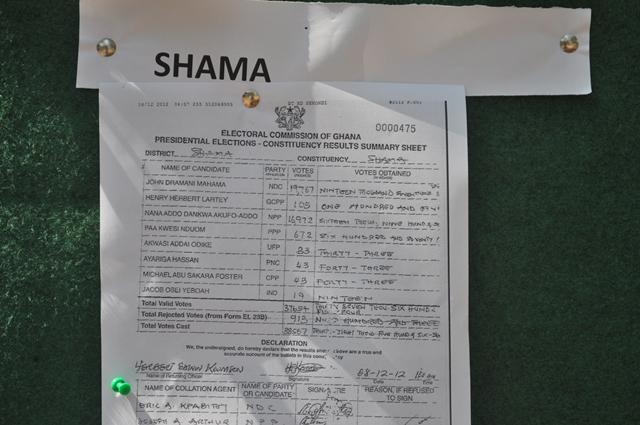
So are images like this one: the results from a specific polling place, publicly posted. In Zimbabwe's last presidential election, posting these votes allowed the opposition ZANU-PF to conduct a parallel vote tabulation and contest MDC's assertions that they had won outright. Parallel tabulation efforts are underway in Ghana, as well, with multiple monitoring, civil society and media organizations trying to ensure that the electoral commission's results are in line with the reports at tens of thousands of polling places.

I'l be very interested to learn what my friends Mike Best at Tom Smyth at Georgia Tech and the team at PenPlusBytes learn from their experiments in social media monitoring. (Disclosure: I'm on the board of PenPlusBytes, and am advising Tom's on his dissertation.) They've been aggregating tens of thousands of reports via Twitter, Facebook and blogs, and following up on reports of violence or conflict. By monitoring Ghana's peaceful elections, they hope to establish best practices for using their tools in monitoring more contentious ones, hoping to defuse violence before it unfolds.

I'll offer two disappointments in Ghana's elections. One is that Ghana continues moving towards being a purely two-party state. One of the benefits of a two-round electoral system (which forces a run-off if no one receives 50% + 1 vote in the first round) is that it encourages people to vote for smaller parties to express preferences, knowing they can vote strategically in a second round. But Ghanaian politics appears to have turned into a battle between NDC and NPP, with few surprises, even when the third party candidates are smart, engaging and adding to the dialog.

Second, NDC and NPP allegiances often have more to do with geography and tribe than with platform. I saw a dispirited tweet last night that suggested the best way to improve your electoral chances was to increase the birthrate in the parties' respective strongholds. It's disappointing to see elections based more on ethnicity than on issues, but it's also clear this isn't the reason behind everyone's vote.

Here's hoping that a close race remains and peaceful one and that Ghanaians continue to have justifiable pride in a robust and transparent electoral system and a healthy democracy.

Ghana Elections 2012 : Presidential and parliamentary election produces amazing outcome in Western Region

Presidential and parliamentary election produces amazing outcome in Western Region

     Takoradi, Dec. 08, GNA - This year's presidential and parliamentary elections have produced amazing outcomes in the Western Region with some New Patriotic Party (NPP) incumbent members of parliament suffering defeat.
     Mr Samuel Johnfiah of the NPP, who had been voted into parliament on three consecutive occasions, suffered defeat to Mr George Kwame Aboagye of the National Democratic Congress, who was also a former chief executive officer of the Ghana Investment Promotion Council (GIPC).
      The former Western Regional Minister under the President Kufuor-led administration, Mr Joseph Boahen Aidoo surprisingly lost to virtually unknown NDC candidate, Akwasi Oppong Fosu in the Amenfi East Constituency.
      In the Evalua-Gwira Constituency, Madam Catherine Abelema Afeku, who was the incumbent MP in the area lost her seat to NDC candidate, Kweku Temakyi-Kessie.
     In the Jomoro Constituency, the only seat held by the Convention Peoples Party by Madam Samia Yaba Nkrumah was lost to the NDC candidate Wing Commander Francis Kablan-Anaman (Rtd).
      However, some NPP gurus in the region managed to retain their seats after a hot contest.
      Those who narrowly retained their seats included Papa Owusu Ankomah in the Sekondi Constituency, Mr Joe Ghartey for Essikado-Ketan defeated NDC's Thomas Charlie Brown whilst Joe Baidoo-Ansah sailed through narrowly  in the newly created Kwesiminstsim seat by defeating NDC's Francis Apuri.
      In Takoradi, the incumbent NPP MP, Kwabena Okyere Darko-Mensah, defeated his closest rival, Alfred Ekow Gyan of the NDC whilst Madam Gifty Eugenia Kusi retained the Tarkwa-Nsuaem seat for the NPP by defeating Madam Christina Kobbina, NDC candidate, who is also the municipal chief executive.
      Meanwhile, the NDC had gained more grounds in the region by sweeping about 18 seats out of 26 improving upon the hitherto 11 seats.
       In the Shama Constituency, the incumbent NDC MP, Gabriel Kwadwo Essilfie, retained his seat by defeating his closest rival, Joseph Cantamanto Gabrah of the NPP.
     The Deputy Energy Minister, Mr Emmanuel Armah Kofi-Buah, defeated his opponent, Kwesi Bonzoh, in the Ellembelle Constituency.
      Paul Evans Aidoo, Western Regional Minster, also won his seat in the Sefwi-Wiawso by defeating Dr Kweku Afriyie of the NPP.
      Smek Ackah also won Suaman for the NDC whilst Sampson Ahi, who was MP for Juaboso, but as a result of division of that constituency into two; Bodi and Juaboso, he contested the Bodi seat and won decisively.
      Moreover, both NDC and NPP new entrants managed to win seats in the newly created constituencies.
       Joseph Cudjoe of the NPP won the newly created Effia Constituency by defeating the presiding member for the Sekondi-Takoradi Assembly, Mohammed Ali of the NDC.
        George Kwame Aboagye of the NDC surprisingly defeated NPP's sitting MP, Samuel Johnfiah in the Ahanta West Constituency in a keenly contested poll.
       Mr Kweku Temankyi-Kessie, a new entrant for the NDC, defeated the sitting NPP MP, Madam Catherine Afeku in the Evalua-Gwira.
       The region is relatively calm as people are glued to their television sets and radios monitoring the elections.
       The election security taskforce are still patrolling the region to curb any eventualities.

GNA

Ghana Elections 2012 : Four arrested for double registration

The Election Rapid Deployment Force (RDF) in the Eastern Region arrested four people for double registration during last Friday's polls.
      All the four were exposed by the Biometric Verification Device (BVD) when they attempted to vote at different polling stations across the region.
     At Korle Nkwanta Anglican Primary School Polling Station in the New Juaben South Constituency, Simon Kwaku Addo,50,  has two pictures popping up when he placed his finger on the BVD and when the police interrogated him, he confessed as having also registered at Kade and was handed over to the task force.
      Joseph Koranteng, also known as Kofi Koranteng, 52, also had his two pictures popping up when he placed his finger on the BVD at Effiduase Methodist JHS Polling Station and when confronted, he confessed to also registering at the Koforidua Zongo Clinic Polling Station.
       Addo and Koranteng are currently being held at the Eastern Regional Police Headquarters for further investigations.
       Esther Odame and Emmanuel Kwame Twum were also arrested for double registration when they attempted to vote at Gyankrom Polling Station, near Nsawam and are being held at the Nsawam Police Division Headquarters of the Police Service for further investigations and prosecution.
      At Akyem Awisa L/A Primary School and JHS Polling Station, Alex Asante, 45, was arrested for double registration and when he was searched, two voter ID cards were found on him, the two cards bearing his pictures but the other card bearing the name, Eric Adom, 44.
      The suspect was arrested and is now in detention at the Akyem Swedru Police Headquarters for further investigation and prosecution.
      The spokesperson for the Eastern Region Election Security Task Force, Assistant Superintendent of Police Yaw Nketia-Yeboah expressed the appreciation of the Task Force to the youth of Eastern Region for comporting themselves and supporting the peace initiative.
     He said there were a lot of allegations of ballot box snatching and people involved in various election offences but when the task force investigated they all proved to be false.
 
GNA
 

Follow us on twitter today https://twitter.com/ghanaelections   @ghanaelections  #ghanaelections

http://bit.ly/QGxulu

Ghana Elections 2012 : National Election Security Task Force [NESTF] asks for restrain

The National Election Security Task Force [NESTF] wishes to express its profound gratitude to the public for their co-operation and for the good behaviour they have put up so far in the on-going general election.

This is the time for us to continue to support and co-operate with one another to ensure that voting at the few remaining polling stations are successfully completed. The public are further entreated to continue to maintain the peace the country is enjoying.

We, however, wish implore the members of the public to be moderate in the way they go about their celebration to avoid excesses, as it could erode the gains and successes we have all chalked together.

Furthermore, the public are also advised to exercise patience and wait till the Electoral Commission declares the final results before celebration

This is the time for reconciliation, togetherness and nation building, and we must all jealously guard against the gains made.

The public are however cautioned against attacks on vital installations and other facilities. The Police and their Sister Security agencies will not hesitate to do everything legitimate to maintain law and other.


                                                                                              AG. DIRECTOR/PUBLIC AFFAIRS

                                                                         [CEPHAS ARTHUR] DSP

Friday, December 7, 2012

Ghana Elections 2012 : President Mahama to meet the press

President John Dramani Mahama will address a press conference at 10.00 hours on Saturday, December 8, 2012.
A media invitation said the press conference would focus on pertinent issues arising from the 2012 Presidential & Parliamentary Elections.
Friday's general election was generally peaceful, but it was dogged by rampant cases of late arrival of voting materials at many poling centres. collapse of the biometric verification machines and rejection of the finger prints of eligible voters.
The Electoral Commission (EC) has decided to allow voting to continue in polling centres where the biometric machines failed during voting on Saturday.
The order does not, however, affect those whose finger prints could not be verified by the machines, the Director of Public Affairs of the Electoral Commission, Mr Christian Owusu-Parry, said.
Voters in the affected areas should go back home and return on Saturday when the EC would send new biometric verification machines for them to vote.
There has been a chorus of concern on the collapse of the biometric verification machines or failure to recognise the fingerprint of eligible voters.
There was also concern about the late arrival of voting materials in polling centres.
The Electoral Commission has issued a statement saying all eligible voters in the queue before the close of voting at 1700 hours would be allowed to vote.
The statement signed by Mr Kwadwo Sarfo-Kantanka, Deputy Chairman (Operations) posted on the EC website said: "The Electoral Commission wishes to inform the general public especially registered voters in polling stations where voting did not start early due to the late arrival of election materials, that the Commission has an inbuilt mechanism that will make it possible for all eligible voters who are in the queue before 5:00pm to vote.
"All eligible voters who are in queue before the close of polls at 5:00pm will be offered the opportunity to vote when the poll officially closes.
"The general public is entreated to be patient and allow the process to run smoothly."
Meanwhile, the National Democratic Congress (NDC) on Friday expressed concern about the electoral technical hiccups that has led to the possible disenfranchisement of many voters mainly due to the collapse of the biometric verification machines.
Mr Elvis Afriyie-Ankrah, the Campaign Coordinator of President John Dramani Mahama, told a press conference in Accra that many people were also disenfranchised because the biometric verification machine rejected voters with valid voter's identification cards.
He said there were many polling stations where people had not voted because of the collapse of the machines, citing himself as an example as he had not been able to vote.
"If we want free and fair election the EC should create the conducive atmosphere. The verification machines are not working and people are being told to go home. This is unacceptable," Mr Afriyie-Ankrah said.
Mr John Jinapor, Presidential Spokesperson, argued that people with valid biometric voter identification cards who had been rejected by the verification machines should be allowed to vote.
"People are being punished because a machine has rejected them. The EC should take appropriate steps to allow people to vote. It is a constitutional requirement," he said.
"To disenfranchise people is unacceptable. Whoever is eligible, whoever is in the queue should be allowed to vote."
GNA


Powered by www.africanelections.org  covering African elections since 2008   A project of www.penplusbytes.org

Follow us on twitter today https://twitter.com/ghanaelections   @ghanaelections  #ghanaelections

 visit : tp://bit.ly/QGxulu