Thursday, December 7, 2023

#EgyptDecides2023: Meet the Presidential Candidates


Egyptians will be heading to the polls from 10th to 12th December to elect their next president who will steer the affairs of the country for the next six years. In all, four people have been cleared by the National Elections Authority (NEA) to contest in this year’s election. They are incumbent president Abdel Fattah El-Sisi, Abdel-Sanad Yamama from the WAFD party, Hakem Omar from the Republican People’s Party and Farid Zahran of the Social Democratic Party. With a few days to election eve, the African Elections Projects takes a look at the profiles of the presidential candidates.

Abdel Fattah El-Sisi

Abdel-Fattah El-Sisi, 69, is the incumbent president of Egypt. El-Sisi is seeking a third term in office in the upcoming presidential election. He is widely expected to win, as he faces no real threat from his challengers. El-Sisi rose to prominence as a military commander during the 2011 Egyptian Revolution and subsequently became Minister of Defence. In 2013, he led a military coup that overthrew President Mohamed Morsi of the Muslim Brotherhood. He later won the 2014 and 2018 elections with 96%  and 97% respectively.

El-Sisi's presidency has been marked by several significant achievements. He has overseen a period of relative stability in Egypt, and he has made progress on key economic reforms.

However, the country’s current economic situation is dire, with the Egyptian Pound losing half of its value since 2022, and inflation reaching an all-time high. These economic challenges have led to widespread discontent among the Egyptian people.

Furthermore, his record on human rights has been widely criticized. His government has been accused of stifling dissent, curtailing freedom of speech, unlawful arrests and jailing tens of thousands of people without fair trials. 

Abdel-Sanad Yamama

Abdel-Sanad Yamama, 71, is the leader of the country’s oldest liberal party, the Wafd. Yamama. He is a professor of Private International Law at the Faculty of Law, Menoufiya University. 

He holds a master’s degree in International law from Ain Shams University in 1983 and a doctorate in foreign investment in Egypt from the University of Nancy in France in 1988. Before heading the Wafd Party, he worked as a lawyer for the Muslim World League.

He then joined the Wafd party in 2004, which was established after the 1919 revolution against the British occupation.

He was elected as a member of the Supreme Committee of the Wafd Party for 3 consecutive terms, in addition to previously holding the position of chairman of the Legislative and Constitutional Committee.

Hakem Omar

Hakem Omar, 59, is a tourism entrepreneur who currently serves as the leader of the Republican People's Party (RPP), a centre-right political party. He is a strong advocate for individual liberties, the rule of law, and a market-oriented economy.

In 2020, Omar was appointed by El-Sisi to the Senate. He held the position of chairman of the Senate Foreign Relations Committee before submitting his resignation in late September.

In his 2023 campaign, he promised to promote the rule of law, and economic freedom and ensure transparency and accountability in governance.

Farid Zahran

Farid Zahran,  66, is a lawyer by profession, and the leader of the  Social Democratic Party – a party that believes in both free market economics and social justice as part of a free and democratic system.

His campaign focuses on improving the Egyptian economy, through raising productivity levels, attracting foreign direct investments, and expanding agricultural production.

Follow the African Elections Project on Twitter and Facebook @Africanelection for more updates.


All You Need to Know about Egypt’s Upcoming General Elections


Egyptians will be heading to the polls from 10th to 12th December to elect a president who will steer the affairs of the country for the next six years.  This is the third time electorates will be going to the polls to elect a president after the coup d’état in 2013. Unlike previous years when presidential elections took place every four years, the 2019 constitutional amendments in Egypt extended the length of presidential terms to six years. Hence, an incumbent or a past president can stand for a third term.

Who are the Contestants?

Four aspirants are contesting for the presidency including the incumbent Abdel Fattah al-Sisi who is currently serving as Egypt’s sixth president. The other candidates include Farid Zahran of the Egyptian Social Democratic Party, Abdel-Sanad Yamana of the Wafd Party and Hazem Omar, of the Republican People’s Party.

How is the Electoral Process Like?

According to the Egyptian constitution, electoral procedures should begin a minimum of 120 days before the end of the current presidential term. The National Elections Authority, through its official verified Facebook page announced that it launched a database which includes all names and addresses of polling stations across the country, with all data specific to the polling station in which each citizen will cast his vote.  The NEA’s website also allows citizens to request information about their electoral location and verify their votes in the electoral process, according to the national number. Citizens are also given the privilege to change their stations via the website to cast their votes provided the station is within the jurisdiction of the electoral home. According to the NEA, the electoral process outside Egypt took place in 137 embassies and consulates in 121 countries from 1st to 3rd December.

A second round of voting (runoff) would take place on January 5-7 2024 for Egyptians living abroad and on January 8-10 2024 in Egypt if no candidate is successful at securing more than 50% of the vote. However, the NEA will announce the final result on 18th December if there is no runoff.

How many Eligible Voters are Expected to Take Part in the Exercise?

About 67 million voters including those living abroad and within Egypt are registered and eligible to exercise their franchise according to the National Elections Authority.

Who is Eligible to Vote?

·         Three categories of persons stand a chance of casting their ballot in the upcoming general elections. They include: Persons who have attained the voting age of 18 and above; Citizens whose data are recorded in the voter database; Citizens with the national number card or a valid passport containing the national number.

Who is Not Eligible to Vote?

·         Citizens who are mentally unsound

·         Convicts of theft, bribery, and other crimes.

·         Citizens ever found guilty of disrupting political life.

·    Citizens dismissed from government service for committing a crime involving moral turpitude or dishonesty.

What are the issues?

The unrelenting economic crisis in Egypt has been the key focus area each candidate has promised to tackle if given the mandate. According to the World Bank, “nearly a third of Egypt’s population of 104 million people currently live below the poverty line, and almost many are vulnerable to falling into poverty”. Improving productivity, legislative reform, social and educational sectors are areas the candidates have devoted to work on, in order to improve the standard of living of Egyptian citizens.

Who is Likely to Win?

A number of media reports have tipped incumbent Abdel Fattah Al-Sisi as most likely to win. Sisi has won the presidency two consecutive times, in 2014 and 2018. In 2018, he won the election with 97% against his opponent. Analysts also say that Al-Sisi “retains the backing of the security services, most importantly the army, which has become more powerful and expanded its economic development”

Follow the African Elections Project on Twitter and Facebook @Africanelection for more updates.

Thursday, November 16, 2023

Madagascar votes in presidential election amid calls for boycott


Voters in Madagascar Thursday headed to the polls for a presidential election boycotted by several opposition candidates.

Polls opened at 6 a.m. local time (03:00 GMT) and will close at 5 p.m. for 11 million registered voters, according to the election commission.

Thirteen candidates are vying for the post, including incumbent Andry Rajoelina, who is seeking a second term.

Soava Andriamarotafika, the spokesperson for the electoral commission, said provisional results would be released on Nov. 24.

The second round of election will be conducted on Dec. 20 if none of the candidates receives 50% of the vote.

The Southern African Development Community (SADC), the African Union, and the European Union have deployed its election observers.

The campaigns were overshadowed by a series of protests called by opposition aspirants quelled with tear gas.

A coalition of 10 out of 12 opposition candidates, including former presidents Hery Rajaonarimampianina and Marc Ravalomanana, have called on voters to boycott the election over transparency concerns.

Rajoelina held his last campaign rally in the capital Antananarivo on Sunday before thousands of enthusiastic supporters.

There had been speculation Rajoelina’s candidature could be rejected surrounding his dual French-Malagasy nationality. He won the last vote in December 2018, beating Ravalomanana in the second round said to have been marred by irregularities.​​​​​​​

Source: aa.com.tr/en


Wednesday, November 15, 2023

Liberians await election result after George Weah v Joseph Boakai run-off


Counting is ongoing in  Liberia's presidential run-off election after neither of the main candidates won October's first round outright.

Just 7,000 votes separated the current president, retired football star George Weah, and former Vice-President Joseph Boakai.

While Mr Weah won the first round he failed to get more than 50% of the vote, triggering a run-off.

Counting will conclude on Wednesday, the National Elections Commission said.Nine election commission staff arrested over alleged ballot-tampering after October's vote.

The UN also reported clashes between supporters of rival opposition parties.

This is the fourth presidential election since Liberia's second civil war which ended more than 20 years ago after more than 50,000 people died.

The BBC's Moses Garzeawu in the capital, Monrovia, said Liberians had been "hungry to vote" and long queues were reported at polling stations.

The head of the national elections commission, Davidetta Browne-Lansanah, said: "We want to thank all Liberians who left their bed this morning. Stay in the line and vote."

Mr Weah, 57, got 43.8% of the vote in the first round, and Mr Boakai, 78, got 43.4%. Eighteen other candidates ran in the first round.

Mr Boakai has focused on investing in agriculture and infrastructure in his campaigning.

He has also highlighted the need to rescue the nation from what he calls "mismanagement" by Mr Weah's administration.

The president has been talking about improving education and dealing with unemployment.

He has asked voters for more time to see the results of his first-term promises, to root out corruption and improve livelihoods.

Liberia is still recovering from the impact of two civil wars between 1989 and 2003, and the Ebola epidemic that killed thousands of people between 2013 and 2016.

According to the World Bank, the West African nation's economy expanded by 4.8% in 2022, because of "mining and a relatively good agricultural harvest".

This is not the first time the two men have faced each other. In 2017, Mr Weah beat Mr Boakai, gaining 61% of the vote in the second round.

Voting closed at 18:00 GMT  on Tuesday local time on  and results are expected to be announced on Wednesday.

Source: bbc.com


Tuesday, November 14, 2023

Liberia’s Weah and rival Boakai meet again in presidential run-off


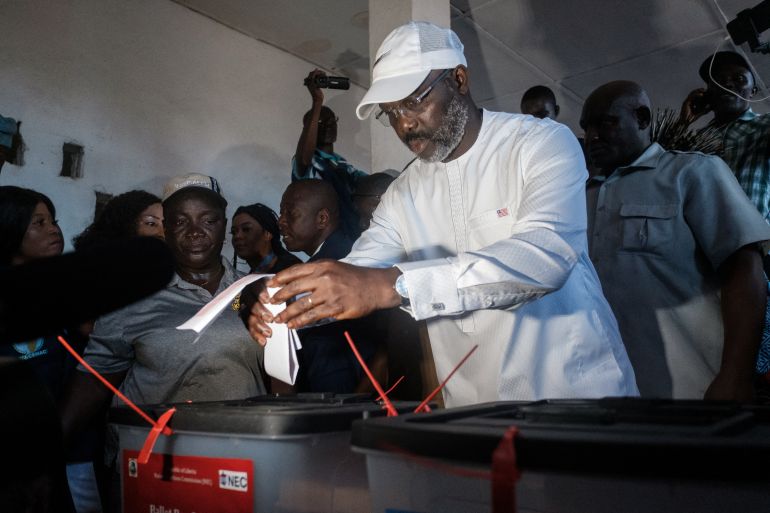
Liberian President Weah votes in polls


Liberians are voting today in a run-off election between President George Weah and former Vice President Joseph Boakai after a fiercely fought first round in which neither was able to score over 50 percent of the vote to secure an outright victory.

Football icon Weah, 57, led the first round in October, gaining 43.83 percent of the vote, and Boakai had 43.44 percent

Analysts say the thin margin of votes between them – just 7,126 votes out of almost two million votes – and the absence of a strong third candidate, means the round will also be very competitive.

The 2023 election has been a rematch of the vote in 2017 when Weah won with over 61 percent.

This is the country’s fourth post-war presidential election but the first one without the presence of the United Nations mission which previously provided support to the country’s elections commission.

Analysts say the election is a referendum on the ruling party’s stint in power so far.

Some voters have become disenchanted with Weah’s performance, particularly on corruption, high rate of youth unemployment, food inflation and general economic hardship. He fired his chief of staff and two other senior officials after the United States imposed sanctions on them for corruption.

Ruling party supporters say a new law in July 2022 granting the anticorruption commission prosecutorial power, is evidence of the administration’s fight against corruption. However, opponents point out that two of the officials sanctioned by the US in 2022 ran for parliamentary seats on the platform of the ruling party.

Weah has blamed the coronavirus pandemic and the consequences of the Russia-Ukraine war for failure to deliver on economic targets.

Source: Aljazeera.com